There are a lot of parameters which effects to the cooling tower design and operation. Some will be discussed here through the examples below.

Example 4-1. The water circulating rate is one of most important primary variables. Obviously it is a key number in the original design. A problem frequently encountered is the prediction of the effects of changes in water circulation rate on the temperatures of the water entering and leaving an existing cooling tower. Assume an existing mechanical draft cooling tower is operating at the following conditions, and estimate the cold & hot water temperature when the water flow rate is increased to 20,000 GPM, assuming no change in the entering air mass flow rate, wet bulb temperature, and heat load. (Actually, the air mass is decreased due to the increase of pressure drop at the fill with the increase of water.)

Given,

  • Water Flow Rate (L1): 16000
  • Entering Air Flow Rate (G1): 80848
  • Ambient Wet Bulb Temperature: 80.0
  • Site Altitude: sea level
  • Hot Water Temperature (HWT, tw2): 104.0
  • Cold Water Temperature (CWT, tw1): 89.0
  • Characteristic Curve Slope (m): -0.800
  • Alternative Water Flow Rate (L2): 20000

(Solution)
Range, R1 = HWT - CWT = tw2 - tw1 = 104 - 89 = 15oF
Water Flow Rate in Pound, L1 = Water Flow Rate x (500 / 60) = 16,000 x (500 / 60) = 133,333.3 lb/min
Heat Load, D1 = L1 x R1 = 133,333.3 x 15 = 2,000,000 BTU/min
Air Mass Flow Rate, G1 = 80,848 lb/min
Liquid to Gas Ratio, L/G1 = L1 / G1 = 133,333.3 / 80,848 = 1.6492
Water Flow Rate in Pound, L2 = Water Flow Rate x (500 / 60) = 20,000 x (500 / 60) = 166,666.7 lb/min
Heat Load, D2 = D1 = 2,000,000 BTU/min
Air Mass Flow Rate, G2 = G1 = 80,848 lb/min
Liquid to Gas Ratio, L/G2 = L2 / G2 = 166,666.7 / 80,848 = 2.0615
Range, R2 = D2 / L2 = 2,000,000 / 166,666.7 or = R1 x (L1 / L2) = 12oF
(The range must be calculated since the heat load is same as the design condition but water flow rate was changed.)

In estimating the cold water temperature with the new water flow rate, there are two methods. One is to find a new approach by means of the computer. Another is to find it using the CTI performance curves. Two methods shall be discussed. With the use of the computer, the iteration is required until the value of the new tower characteristic is exactly equal to the new KaV/L (NTU) varying the approach by means of computer.

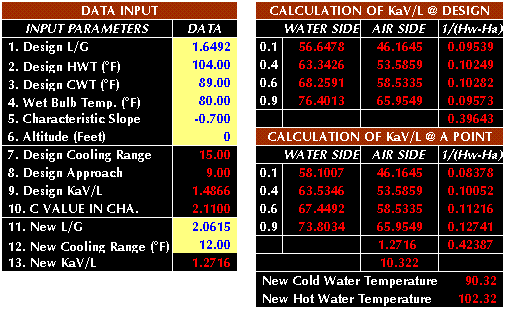
First Step: Calculate NTU at the design conditions as follows;

WATER SIDE

AIR SIDE

ENTH DIFF.

Descriptions

tw (oF)

hw (Btu/Lb)

Description

ha (Btu/Lb)

1/(hw-ha)

tw1 + 0.1 x R

90.50

56.6478

ha1 + 0.1 x L/G x R

46.1645

0.0954

tw1 + 0.4 x R

95.00

63.3426

ha1 + 0.4 x L/G x R

53.5858

0.1025

tw1 + 0.6 x R

98.00

68.2591

ha1 + 0.6 x L/G x R

58.5334

0.1028

tw1 + 0.9 x R

102.50

76.4013

ha1 + 0.9 x L/G x R

65.9547

0.0957

Sum of 1 / (hw - ha)

0.3964

Total Tower Demand (NTU) = Cooling Range x Sum of 1 / (hw - ha)

1.4866

Second Step: Calculate a value of "C" of tower characteristic for the design conditions as follows;

C = KaV/L / (L/G1)-m = KaV/L x (L/G1)m = 1.4866 x (1.6492)0.8 = 2.21825

Third Step: Calculate a new tower characteristic for the increased water flow as follows;

New Tower Characteristic = C x (L/G2)-m = 2.21825 x (2.0615)- 0.8 = 1.2436
(Note that "C" value is a constant value regardless the change of water flow rate in finding the approach at the alternative temperature conditions.) The new tower characteristic for the increased water flow rate can be calculated as above.

Forth Step: Iterate until the value of new characteristic is equal to the new NTU varying the value of approach.


New Cold Water Temperature = Wet Bulb Temperature + New Approach

Fifth Step: Compute the cold water temperature with the result of iteration as follows;

New CWT = WBT + New Approach = 80 + 10.32 = 90.32oF
New HWT = CWT + Range = 90.32 + 12 = 102.32oF

Through this example, it was proven that the cold water temperature at the slope of - 0.7 is slightly lower than - 0.13.

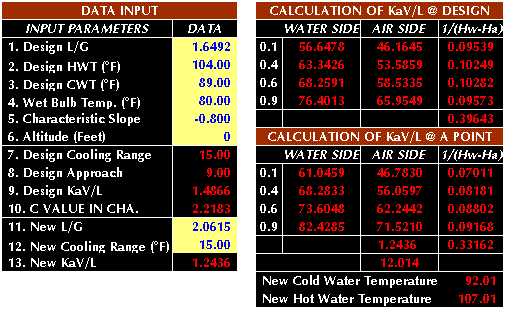
Example 4-3. The example number 18 was based on the assumption that the heat load is constant for the increase of water flow rate. Estimate the cold & hot water temperature under the assumption that the cooling range is constant for the increase of water flow rate to 20,000 from 16,000 GPM.

(Solution)
Range, R1 = R2 = HWT - CWT = tw2 - tw1 = 104 - 89 = 15oF
Water Flow Rate in Pound, L1 = Water Flow Rate x (500 / 60) = 16,000 x (500 / 60) = 133,333.3 lb/min
Heat Load, D1 = L1 x R1 = 133,333.3 x 15 = 2,000,000 BTU/min
Air Mass Flow Rate, G1 = G2 = 80,848 lb/min
Liquid to Gas Ratio, L/G1 = L1 / G1 = 133,333.3 / 80,848 = 1.6492
Water Flow Rate in Pound, L2 = Water Flow Rate x (500 / 60) = 20,000 x (500 / 60) = 166,666.7 lb/min
Heat Load, D2 = L2 x R2 = 166,666.7 x 15 = 2,500,000 BTU/min
Liquid to Gas Ratio, L/G2 = L2 / G2 = 166,666.7 / 80,848 = 2.0615

The value of NTU at the design conditions is same as a value calculated in the example 4-1. The value of "C" of tower characteristic for the design conditions same as the example 4-1. The new tower characteristic for the increased water flow is also same as the example 4-1. Iterate until the value of new characteristic is equal to the new NTU varying the value of approach.

New Cold Water Temperature = Wet Bulb Temperature + New Approach

Fifth Step: Compute the cold water temperature with the result of iteration as follows;

New CWT = WBT + New Approach = 80 + 12.01 = 92.01oF
New HWT = CWT + Range = 92.01 + 15 = 107.01oF

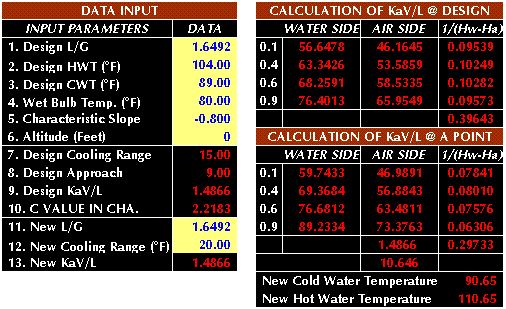
Example 4-4. Assume again the conditions of example 4-1 and determine the cold and hot water temperature when the heat load is added to increase the cooling range from 15 to 20oF, assuming no change in the water circulation rate or in entering air mass flow rate or wet bulb temperature.

(Solution)
Range, R1 = HWT - CWT = tw2 - tw1 = 104 - 89 = 15oF
Water Flow Rate in Pound, L1 = L2 = Water Flow Rate x (500 / 60) = 16,000 x (500 / 60) = 133,333.3 lb/min
Air Mass Flow Rate, G1 = G2 = 80,848 lb/min
Liquid to Gas Ratio, L/G1 = L1 / G1 = L/G2 = 133,333.3 / 80,848 = 1.6492
Range, R2 = 20oF
The value of NTU, and "C" at the design conditions is same as a value calculated in the example 4-1. Also, the new tower characteristic for even a increased cooling range is same as the example 4-1. Iterate until the value of new characteristic is equal to the new NTU varying the value of approach. (New Cold Water Temperature = Wet Bulb Temperature + New Approach)

Fifth Step: Compute the cold water temperature with the result of iteration as follows;

New CWT = WBT + New Approach = 80 + 10.65 = 90.65oF
New HWT = CWT + Range = 90.65 + 20 = 110.65oF

Example 4-5. Assume the existing mechanical-draft cooling tower is operating at the initial conditions of example 4-1. Determine the cold & hot water temperature if the air mass flow rate is reduced to 53,900 lb/min by the adjustment of the fan pitch angle and/or fan speed.

 To be continued. Please press the next button....


(Solution)
Range, R1 = HWT - CWT = tw2 - tw1 = 104 - 89 = 15oF
Water Flow Rate in Pound, L1 = L2 = Water Flow Rate x (500 / 60) = 16,000 x (500 / 60) = 133,333.3 lb/min
Air Mass Flow Rate, G1 = G2 = 80,848 lb/min
Liquid to Gas Ratio, L/G1 = L1 / G1 = L/G2 = 133,333.3 / 80,848 = 1.6492
Range, R2 = 20oF
The value of NTU, and "C" at the design conditions is same as a value calculated in the example 4-1. Also, the new tower characteristic for even a increased cooling range is same as the example 4-1. Iterate until the value of new characteristic is equal to the new NTU varying the value of approach. (New Cold Water Temperature = Wet Bulb Temperature + New Approach)

Fifth Step: Compute the cold water temperature with the result of iteration as follows;

New CWT = WBT + New Approach = 80 + 10.65 = 90.65oF
New HWT = CWT + Range = 90.65 + 20 = 110.65oF

Example 4-5. Assume the existing mechanical-draft cooling tower is operating at the initial conditions of example 4-1. Determine the cold & hot water temperature if the air mass flow rate is reduced to 53,900 lb/min by the adjustment of the fan pitch angle and/or fan speed.

(Solution)
Range, R1 = HWT - CWT = tw2 - tw1 = 104 - 89 = 15oF
Water Flow Rate in Pound, L1 = L2 = Water Flow Rate x (500 / 60) = 16,000 x (500 / 60) = 133,333.3 lb/min
Air Mass Flow Rate, G1 = 80,848 lb/min
Liquid to Gas Ratio, L/G1 = L1 / G1 = 133,333.3 / 80,848 = 1.6492
Air Mass Flow Rate, G2 = 53,900 lb/min
Liquid to Gas Ratio, L/G2 = L2 / G2 = 133,333.3 / 53,900 = 2.4737

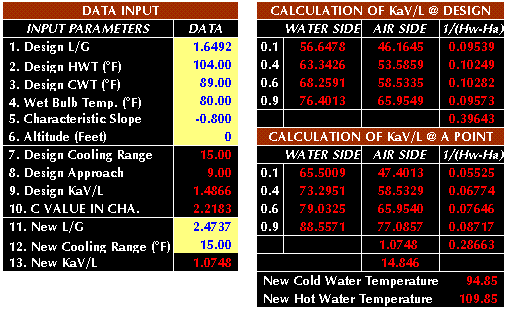
The value of NTU, and "C" at the design conditions is same as a value calculated in the example 4-1.Calculate a new tower characteristic for the decreased air mass flow.

New Tower Characteristic = C x (L/G)-m = 2.21825 x (2.4737)-0.8 = 1.0748
Iterate until the value of new characteristic is equal to the new NTU varying the value of approach. New Cold Water Temperature = Wet Bulb Temperature + New Approach

Fifth Step: Compute the cold water temperature with the result of iteration as follows;

New CWT = WBT + New Approach = 80 + 14.85 = 94.85oF
New HWT = CWT + Range = 94.85 + 15 = 109.85oF

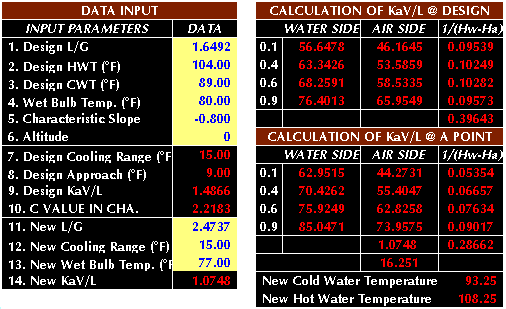
Example 4-6. Assume that the cold & hot water temperature at the conditions where the wet bulb temperature is decreased to 77oF from 80oF and the air mass flow is changed to 53,900 lb/min. Others remain unchanged from example 4-1.

(Solution)
Range, R1 = R2 = HWT - CWT = tw2 - tw1 = 104 - 89 = 15oF
Water Flow Rate in Pound, L1 = Water Flow Rate x (500 / 60) = 16,000 x (500 / 60) = 133,333.3 lb/min
Air Mass Flow Rate, G1 = 80,848 lb/min
Liquid to Gas Ratio, L/G1 = L1 / G1 = L2 = 133,333.3 / 80,848 = 1.6492
Air Mass Flow Rate, G2 = 53,900 lb/min
Liquid to Gas Ratio, L/G2 = L2 / G2 = 133,333.3 / 53,900 = 2.4737

The value of NTU, and "C" at the design conditions is same as a value calculated in the example 4-1. Calculate a new tower characteristic for the decreased air mass flow.

New Tower Characteristic = C x (L/G)-m = 2.21825 x (2.4737)-0.8 = 1.0748

Forth Step: Iterate until the value of new characteristic is equal to the new NTU varying the value of approach. New Cold Water Temperature = Wet Bulb Temperature + New Approach

Fifth Step: Compute the cold water temperature with the result of iteration as follows;

New CWT = WBT + New Approach = 77.0 + 16.25 = 93.25oF
New HWT = CWT + Range = 93.25 + 15 = 108.25oF

Download the example file(exe4_6.zip)